

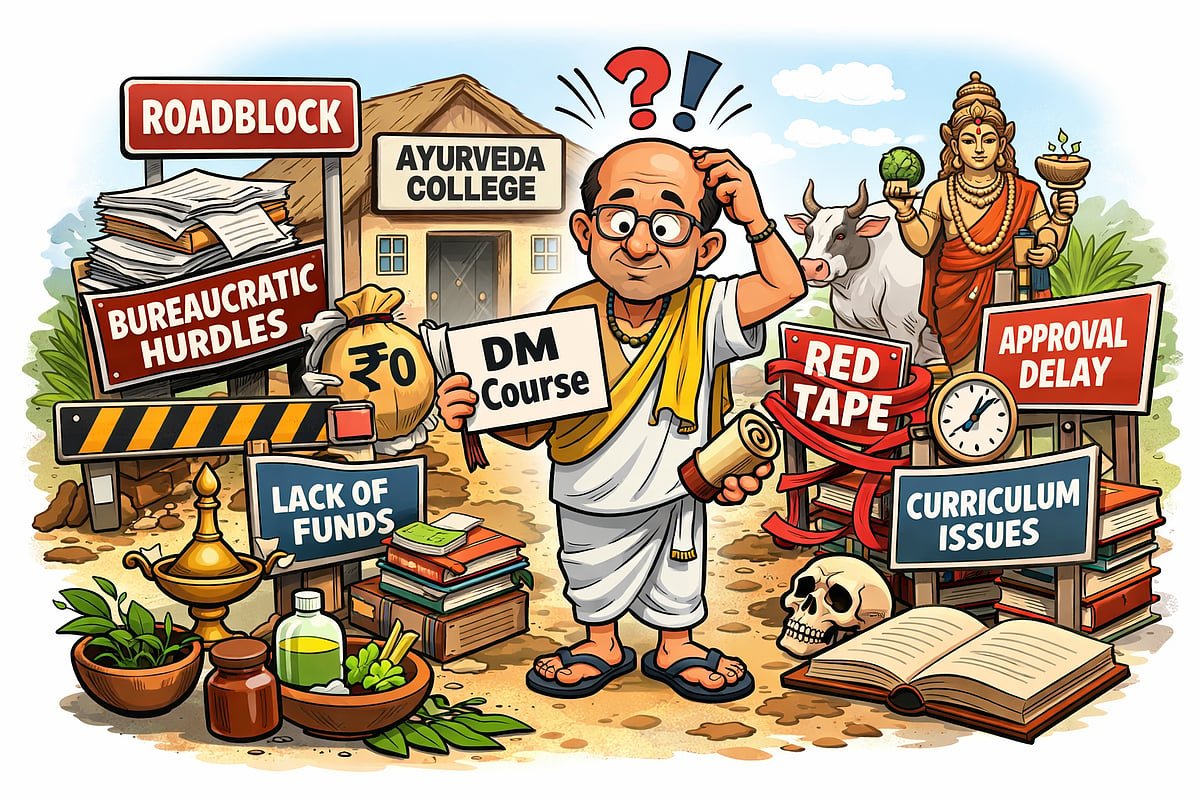
Ayurveda colleges in Bhopal and across Madhya Pradesh are encountering significant hurdles in initiating DM courses despite receiving Union approval. These challenges mainly stem from the necessity to obtain state NOCs, bolster faculty, and satisfy stringent infrastructure and research criteria demanded by the National Commission for Indian System of Medicine. These developments are critical as the proposed DM programs aim to cover vital fields such as psychiatry, oncology, and hepatology, thus expanding the scope of Ayurveda into super-speciality domains.
Challenges Facing DM Courses in Ayurveda Colleges
To effectively launch DM courses in Ayurveda colleges, institutions need to address several critical challenges. Firstly, securing state NOCs remains a significant roadblock. These are essential for confirming the institution’s compliance with state regulations and ensuring they meet the local educational standards. Consequently, the process can be time-consuming and complex, delaying the establishment of these courses.
Infrastructure and Faculty Requirements
Strengthening the faculty and meeting infrastructure standards are equally daunting tasks. Ayurveda colleges must bolster their teaching workforce to provide high-quality education. Additionally, the infrastructure must comply with rigorous standards set by the National Commission for Indian System of Medicine. These requirements ensure that students receive education and training that matches national and international standards, thus preparing them for future medical challenges.
Impact of DM Courses on Ayurveda Education
Implementing DM courses in these colleges could profoundly impact Ayurveda education by elevating its academic and professional scope. Moreover, by specializing in areas like oncology and psychiatry, Ayurveda can contribute to broader healthcare solutions and integrate more effectively with modern medical practices. Therefore, overcoming these initial hurdles could pave the way for Ayurveda to significantly enhance its contribution to global healthcare.
Regulatory and Research Standards
The adherence to strict research guidelines further complicates the introduction of DM courses. Colleges must establish comprehensive research programs that align with national standards. These efforts involve substantial investments in research facilities and training programs for both students and faculty. Consequently, achieving these standards would signify a robust alignment with the best practices within the medical academic community.
In conclusion, while the hurdles faced by Ayurveda colleges in implementing DM courses are significant, overcoming them could vastly enhance the discipline’s educational and clinical contribution. These advancements align with the broader vision of integrating traditional and modern medicine, promising enriched healthcare outcomes for society.
Key Takeaways
- Securing state NOCs remains a fundamental challenge for Ayurveda colleges aiming to start DM courses.
- Enhanced faculty and infrastructure are critical for achieving the educational standards required for DM courses.
- Introducing DM courses in Ayurveda can potentially elevate its role within the global medical community.
Medical Disclaimer
The information provided in this article is for educational purposes only and should not be considered as medical advice.
